What is Spec-Driven Development? A Complete Guide
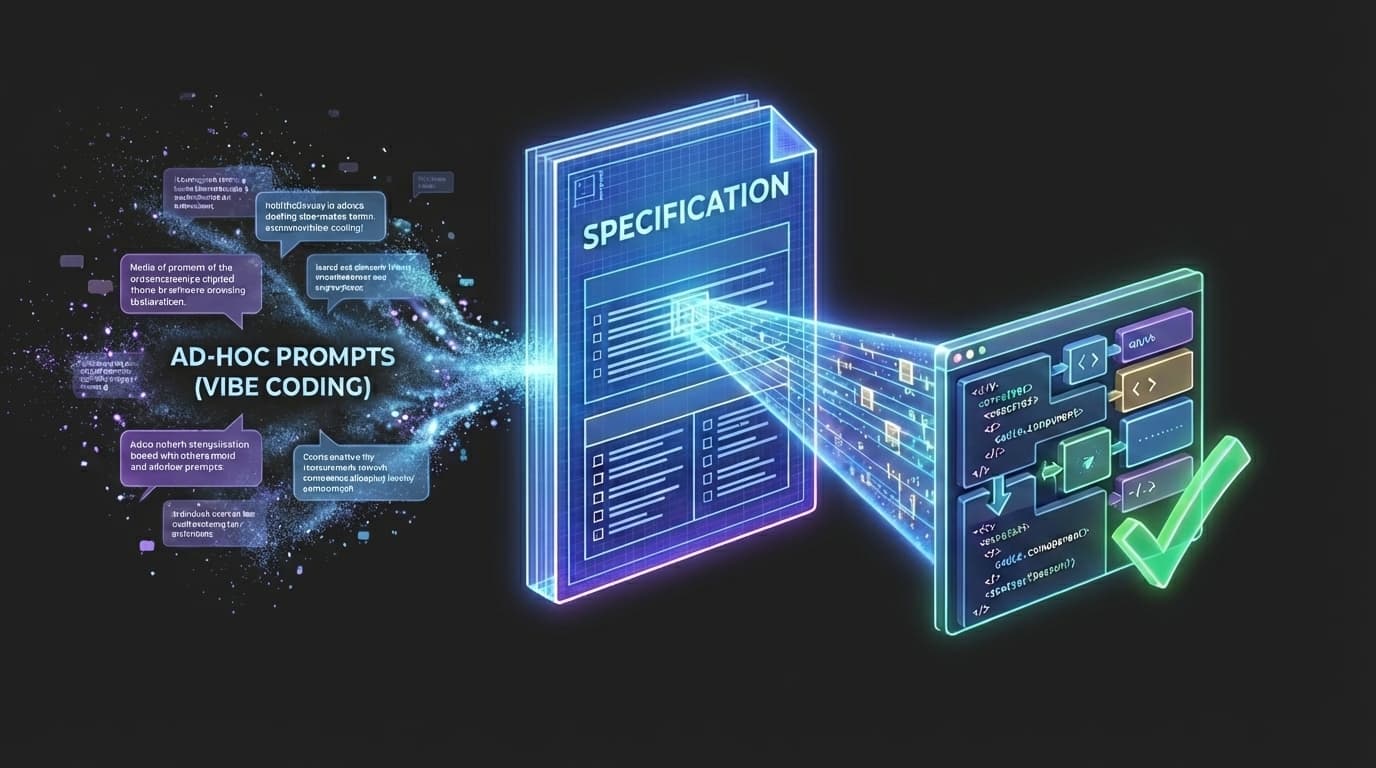
Spec-driven development is a software development methodology where structured specifications drive the entire AI-assisted development lifecycle. Instead of describing features in chat and hoping for the best, you define specs with acceptance criteria, affected files, and implementation tasks. AI queries the spec, implements against it, and you verify the result.
This is the professional alternative to vibe coding. Models come and go. Prompts are ephemeral. Specs persist across sessions, tools, and team members.
Quick Definition#
Spec-driven development: A methodology where AI coding tools operate against structured specifications rather than ad-hoc prompts. Specs define what to build, acceptance criteria define done, and automated scans verify the implementation.
Previously explored as "context-driven development" (CDD), which focused on bringing deterministic context into the editor. Spec-driven development builds on that foundation with a concrete methodology: the spec is the context.
The Problem: AI Without Structure#
AI coding tools are fast. They generate code in seconds. But speed without direction creates a different kind of technical debt.
The vibe coding loop:
- Describe a feature in chat
- AI generates code
- It mostly works, but misses edge cases
- Describe the fix in another chat message
- AI patches it, breaks something else
- Repeat until it seems right
- Ship and hope
The result: code that works but nobody understands why. No traceability from requirements to implementation. No way to verify completeness. Context is lost between sessions. A different AI (or teammate) starts from zero.
The spec-driven loop:
- Define a spec with acceptance criteria and tasks
- AI queries the spec via MCP server, knows exactly what to build and which files to touch
- AI implements against the spec
- You commit, and the commit links back to the spec
- Scan to verify the fix
- Spec tracks what's done, what's left, and why decisions were made
Why Specs, Not Prompts#
Prompts are instructions for a single moment. Specs are durable artifacts that persist.
Prompt-Driven
Spec-Driven
The difference is structural. A prompt says "fix the SEO." A spec says "add canonical tags to these 4 URLs, verify with a crawl, here are the affected files."
How Spec-Driven Development Works#
The Workflow#
Define a spec (or let Rampify create one from a scan)
    |
AI queries the spec via MCP server, knows what to build
    |
AI implements the change
    |
You commit, the commit links back to the spec
    |
Scan again to verify the fix
Manual Specs: You Define What to Build#
You create a spec when you know what needs to happen. The spec includes a description, acceptance criteria, implementation tasks, affected files, and tech stack. Any AI coding tool can retrieve it via the MCP server and implement against it.
"Get the feature spec for auth token expiration"

AI: *calls get_feature_spec()*
    "Spec: Implement token expiration logic

     Acceptance criteria:
     1. Tokens expire after 15 minutes
     2. Refresh tokens last 7 days
     3. Expired tokens return 401

     Tasks:
     1. Add expiration check in lib/auth.ts
     2. Update verify endpoint
     3. Add refresh token flow

     Affected files: lib/auth.ts, app/api/auth/verify/route.ts

     Starting with task 1..."
The AI doesn't guess what to do. It reads the spec and executes.
Auto-Generated Specs: Rampify Defines What to Fix#
Run a scan, and Rampify analyzes your site for real issues. Each issue becomes a spec with affected URLs and fix instructions. No manual triage needed.
After scan:
  - "Missing Canonical Tag" (4 URLs affected)
  - "Pages Missing Structured Data" (3 URLs affected)
  - "Meta Description Too Short" (2 URLs affected)

Each is a spec your AI can pick up and fix immediately.
This is where spec-driven development and AI SEO tools converge. The scan is deterministic (real crawl data, not AI opinions), and the output is a structured spec that any AI coding tool can act on.
The Verification Loop#
After AI implements a fix, you don't just trust it. You scan again. Rampify re-crawls the affected URLs and checks whether the issues are resolved. If they are, the spec is automatically marked as verified. If not, it stays open with updated affected URLs.
This closes the loop: define, implement, verify.
Core Principles#
1. Determinism Over Plausibility#
Facts must come from crawlers, APIs, and authoritative sources, not LLM weights or training data.
When you ask an LLM "is my site SEO-optimized?" without tools, it guesses. It might say "looks good!" without checking anything. With spec-driven development, the AI calls a real tool that crawls your site, queries Google Search Console, and returns measured data. The spec captures what was found and what needs to change.
2. Specs as the Single Source of Truth#
The spec is the authority. Not the chat log. Not the PR description. Not someone's memory of what was discussed.
A spec contains:
- What to build (title, description)
- Why it matters (context, business value)
- How to verify it's done (acceptance criteria)
- Where to implement it (affected files, tech stack)
- What's next (ordered tasks with dependencies)
- What happened (linked commits, progress tracking)
When a new developer joins, when you switch AI coding tools, when you resume work after a week, the spec has everything.
3. AI as Interface, Data as Truth#
AI is a powerful interface. But it should operate on top of structured data, not instead of it.
AI excels at natural language understanding, code generation, explaining issues, and recommending approaches. Deterministic systems handle crawling, measuring, validating, and storing facts. Spec-driven development keeps these concerns separate: the MCP server provides real data, the AI provides the interface.
4. Verification Closes the Loop#
Implementation without verification is just hope. Spec-driven development requires a verification step: scan the site, check the URLs, compare against acceptance criteria. This is what separates a professional workflow from vibe coding.
Real-World Example: Fixing SEO Issues#
Traditional Workflow#
- Run an SEO audit tool in the browser
- Export a spreadsheet of issues
- Open your editor
- Try to remember what the spreadsheet said
- Fix some issues, miss others
- Deploy and re-run the audit
- Discover you missed half the issues
- Repeat
Total time: days. Issues slip through.
Spec-Driven Workflow#
# Run a scan from your editor
"Scan my site for SEO issues"

AI: *calls crawl_site()*
    "Scan complete. 3 specs created:

     1. Missing Canonical Tag (4 URLs)
        Fix: Add <link rel="canonical"> to /login, /signup, /terms, /privacy

     2. Pages Missing Structured Data (3 URLs)
        Fix: Add JSON-LD schema to /terms, /privacy, /blog

     3. Wrong Schema Type on Pricing Page
        Fix: Replace WebPage with SoftwareApplication + Offer schema

     Which spec should I start with?"

# AI implements each fix, you commit, scan verifies
Total time: minutes. Nothing slips through.
For a complete guide to the technical architecture behind this, see our Spec-Driven Development documentation.
Real-World Example: Using GSC Data for Content Decisions#
Spec-driven development isn't just about fixing bugs. It's about making data-driven decisions in your editor.
# In Claude Code or Cursor
"What content should I write next based on my search data?"

AI: *calls get_search_performance()*
    "Based on your GSC data (last 28 days):

     Top opportunity:
     - 'spec-driven development' ranking at position 5.5
     - 8,100 impressions, low CTR
     - Recommendation: Expand content, improve meta description

     Quick wins:
     - 'ai seo tools' at position 10.2 (2,900 impressions)
     - 'mcp server setup' at position 4.5 (low volume but high intent)

     Want me to create a feature spec for the content update?"
The AI retrieved real data from Google Search Console via the MCP server. No guessing. No hallucination. You make decisions based on facts.
Setting Up Spec-Driven Development#
Step 1: Sign Up#
Create a free account at rampify.dev/signup.
Step 2: Install the MCP Server#
The MCP server connects your AI coding tools to Rampify specs and site intelligence.
# For Claude Code
claude mcp add --transport http rampify \
  https://www.rampify.dev/api/mcp \
  --header "Authorization: Bearer sk_live_your_api_key_here"

# For Cursor — add to .cursor/mcp.json
{
  "mcpServers": {
    "rampify": {
      "type": "http",
      "url": "https://www.rampify.dev/api/mcp",
      "headers": {
        "Authorization": "Bearer sk_live_your_api_key_here"
      }
    }
  }
}
Step 3: Install the VS Code Extension#
Search "Rampify" in the Extensions panel or install from the VS Code Marketplace. Browse specs in the sidebar, copy references into AI chat, and toggle resolved specs.
Step 4: Run Your First Scan#
Ask your AI to scan your site. Rampify creates specs for every issue it finds. Pick one and tell your AI to implement it. Commit the fix. Scan again to verify.
That's spec-driven development. Define, implement, verify.
Beyond SEO#
Spec-driven development is a general methodology. Rampify currently implements it for SEO, where scans create specs from real site issues. The same pattern applies to any domain:
- Accessibility scanning for WCAG violations, creating specs with affected components
- Security scanning for vulnerabilities, creating specs with remediation steps
- Performance scanning for Core Web Vitals issues, creating specs with optimization targets
The architecture is the same: deterministic scan produces structured findings, findings become specs, AI implements against specs, scan verifies the fix.
Frequently Asked Questions#
How is spec-driven development different from project management tools?#
Project management tools track work at the team level. Spec-driven development operates at the code level. Your AI coding tool retrieves the spec via MCP server, knows which files to touch, and implements against acceptance criteria. A Jira ticket can't do that.
Do I need AI to practice spec-driven development?#
Specs are useful without AI. But AI makes them dramatically more powerful because the AI can query specs via MCP, understand the full context, and implement against them. Without AI, specs are documentation. With AI, specs are executable instructions.
Can spec-driven development work with any AI coding tool?#
Yes. Any tool that supports the Model Context Protocol (MCP) can query Rampify specs. This includes Claude Code, Cursor, Copilot, and Windsurf. The spec is the structured layer underneath, independent of which model you use.
What happened to "context-driven development"?#
Spec-driven development evolved from context-driven development (CDD), which we introduced in 2025. CDD focused on bringing deterministic context into the editor. Spec-driven development takes that further with a concrete methodology: specs define what to build, acceptance criteria define done, and automated scans verify the result. The context is now structured as specs.
Conclusion#
Spec-driven development represents a shift from ad-hoc AI prompting to structured, verifiable software engineering. Define what to build. Let AI implement against the spec. Verify with a scan. Track everything.
The tools exist today. The MCP server connects AI to specs. The VS Code extension puts specs in your sidebar. The scan pipeline creates specs from real site data. Commits link back to specs for full traceability.
Stop vibe coding. Start spec-driven development.
Try spec-driven development with Rampify
Scan your site, pull real Search Console data, and create specs directly from your AI coding tools. Every commit links back to its spec, so the work stays verifiable from plan to production.
Get Started FreeRelated Reading
Spec-Driven Development
How living specs keep AI-assisted work aligned as the codebase evolves.
Spec-Driven Development with Real Data
Feed real Search Console and keyword data into your specs so the AI builds against evidence.
Claude SEO Checker
Run the read-write SEO loop from Claude, audit a page then write and verify the fixes.